The Cardboard Compass: Why Margate Festival 2026 Still Runs on Felt-Tip and Goodwill
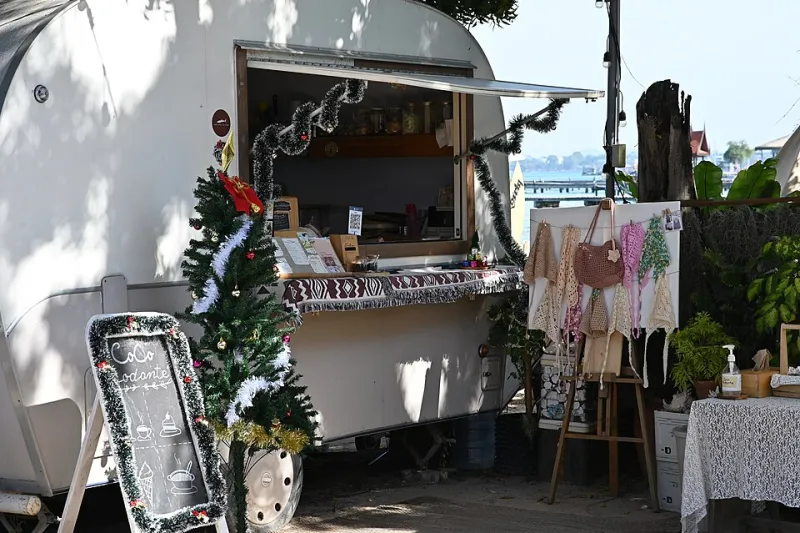
Photo: PattayaPatrol, CC BY-SA 4.0, via Wikimedia Commons
There is a moment, somewhere between the harbour and the Old Town, when your phone gives up. The signal thins, the battery dips, and the festival app — which looked so tidy at home — starts spinning like a washing machine with a brick in it. Then you see it: a sheet of A4 in a plastic wallet, Sellotaped to a railing, with the words ‘THIS WAY FOR THE GOOD STUFF’ and an arrow that points roughly towards a pub. You follow it. Of course you do.
At Margate Festival 2026, the official programme is useful, the app is fine, and the printed guide is a nice thing to lose in a tote bag. But the network that actually moves people around town is far older and far stranger. It is chalk. It is marker pen. It is a cardboard arrow cable-tied to a lamppost by someone who clearly had three minutes and a strong opinion about pedestrian flow.
The gospel according to a laminated arrow
Spend an afternoon walking the festival footprint and you start to notice the signs as a kind of exhibition. There are chalk A-boards outside pubs, listing times that have been rubbed out and rewritten so often the board looks like a weather map. There are laminated notices at the entrance to smaller venues: ‘STAGE FULL — TRY THE CHURCH HALL’. There are arrows made from delivery boxes, the corrugated edges still visible, with ‘TO THE ARCHES’ in fat black marker. One sign near a pop-up coffee hatch simply reads: ‘YES, IT’S THIS WAY. NO, WE DON’T KNOW WHY IT’S SO FAR.’
I spoke to a bar supervisor at a seafront venue who was midway through replacing a rain-sodden sign with a fresh one. She said the chalkboard is the first thing they update when a set time shifts. ‘You can’t wait for an app update when a band is late and forty people are standing in the wrong yard,’ she said. ‘You rub it out, you write the new time, you add an arrow. It’s done in seconds. People trust it because they can see someone made it.’
That phrase stayed with me: someone made it. A printed sign is a decision from above. A handwritten sign is a conversation. The wonky lettering admits that the day is not going entirely to plan, and that the plan is being adjusted by a human being with a pen and a bit of local knowledge.
Why we believe a wobbly arrow more than a blue dot
There is a practical case for low-tech wayfinding. Apps need signal, battery, updates and a certain amount of faith in the organisation behind them. A sign needs a wall and a dry-ish afternoon. It works when your phone is dead. It works when you are eight years old and have no phone. It works when your hands are full of chips and you cannot swipe.
But the trust goes deeper than utility. A hand-drawn sign shows its working. If it says ‘STAGE FULL’, you can see that someone has looked at the stage, judged the crowd, and made a call. If a chalkboard says ‘BACK IN FIVE’, you believe it in a way you would never believe a website that has not been updated since Tuesday. The imperfections are the proof of life.
There is also a social dimension. A sign is a shared reference point. You can stand next to it, point at it, ask a stranger what they think it means. The app gives you a private route. The sign gives you a small, temporary community of people all squinting at the same arrow and hoping for the best.
The weather is the co-designer
Margate’s festival signage is shaped by sea air and the possibility of rain. Chalk smudges. Marker bleeds. Laminating pouches steam up in the sun and then fog in the evening. The signs evolve over the weekend like a living document. An arrow gets a second arrow added. A time gets crossed out and replaced. A note appears at the bottom: ‘SORRY — WE MOVED THE DOOR.’
One volunteer at a smaller venue told me they now keep a ‘sign kit’ behind the bar: blank boards, a box of chunky chalk, a roll of gaffer tape, a handful of laminated sleeves and a permanent marker that is always, somehow, running out. ‘You learn to write for the weather,’ they said. ‘Big letters. Short words. Don’t put the important bit at the bottom where the puddle gets it.’
That is a design philosophy, even if nobody would call it one. It is also why the signs feel like part of the festival’s character rather than a temporary interruption of it.
A map of Margate in marker pen
The signs reveal the town’s sense of humour. One chalkboard outside a pub advertised ‘LOUD BAND, QUIET COBS’ and a smaller line underneath: ‘ASK INSIDE’. A cardboard arrow near the station pointed to the seafront with the note ‘SEA IS THAT WAY, PROBABLY’. A laminated notice on a church hall door said ‘NO NEED TO WHISPER — IT’S A FESTIVAL’.
This is not corporate wayfinding. It is local knowledge made visible. The signs know which alley floods, which gate gets busy, which pub has a back room that is closer than it looks. They use shorthand that only makes sense if you have been here before, and then they explain it to you anyway. That combination — insider and welcoming — is hard to bottle.
What the scribbles say about Margate Festival 2026
There is a tendency to treat low-tech solutions as a compromise. At Margate Festival 2026, they look more like a preference. The app is there if you want it. The guide is there if you planned ahead. But the handwritten sign is the thing that catches your eye when you are lost, tired, slightly sunburned and in need of a toilet or a bassline.
If the festival wants to protect that feeling, the lesson is not to replace the signs with screens. It is to give the sign-makers better pens. Keep a stack of blank boards behind every bar. Nominate someone to do a midday walk-around with a fresh piece of chalk. Treat the cardboard arrow as a legitimate piece of festival infrastructure, not an afterthought.
And maybe leave room for the odd mistake. A sign that says ‘THIS WAY’ and then, underneath, ‘SORRY, OTHER WAY’ is not a failure of wayfinding. It is a tiny piece of theatre. It tells you that Margate Festival 2026 is being run by people, not a platform — and that, somehow, is the most reassuring direction of all.